
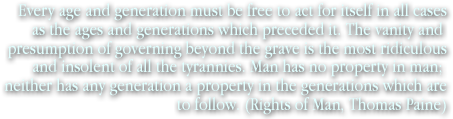

What Is Common Sense?
Apr
24th

[I must apologize again to regular readers for the length of time between new posts at Common Sense. My only excuse is that as I prepare to run a campaign for Congress, I have less time to spend on the blog. In that spirit, I offer a repost of the second essay ever to appear here on this site. I hope to have something new for readers soon, but in the meantime, here is something you’ve probably not seen before, unless you’ve been digging through the archives.]

Common Sense….an inborn trait that most of us possess. Common sense is the ability to view a situation and discern the proper thing to do. Proper as defined by our system of laws and morals. Common sense developed to warn us that all was not right in the world around us. Its daily application probably kept our ancestors from becoming dinner long enough to propagate the species. Without this ability, humankind could not have gone as far as it has. As our capabilities progressed, as we tamed nature, common sense spread into more areas of our lives. We learned to hone the instinct of common sense and apply it to all areas of life. Common sense lets you know that an umbrella can keep you dry on a rainy day. Common sense reminds you to use the bathroom before boarding a seven-hour flight. Common sense says that robbing the bank will get you arrested. We all possess, to some degree, a measure of common sense.

Why then does it seem that so many of our legislators and educators and scientists lack this innate ability? Or do other, less attractive traits overshadow the application of common sense in today’s daily life? It is difficult to believe that the highly educated leaders or our society could lack such a basic survival skill as common sense. Therefore, we can only surmise that they suppress this ability for some purpose. What could cause someone, especially someone entrusted with the public welfare, to abandon the one trait that warns of trouble or danger? Whatever it could be, you can be sure that the suspension of common sense is often accompanied by two things- personal profit of some kind, and eventual downfall.

The personal profit derived can take shape in many ways. For some, financial reward is enough to do the trick. For others, it is the thought of gaining power that makes the sharp eye dull. Some just seek the perception of greatness, even if only over a peer. The form of profit is as different as the people who throw away their common sense. If their transgressions come to light, though, and the clarity of what should have been done is addressed, those who seek profit usually end up taking a fall. And eventually, when the cards come tumbling down, the mess they leave behind lingers like an old piece of Limburger cheese.

Today, our leaders seem to embrace the lack of common sense through the use of “Political Correctness.” The belief that calling a black kettle blue will result in more harmony between all the pots and pans has not proven itself true. The hope that by embracing all behavior types or offering all things to all people will create a better world has been refuted by the state of our society. Our schools, in an effort to be all things to all people, have instead failed in doing what they were designed to do, which is to teach our children the fundamentals of knowledge. Our industries, in an effort to earn more profit than the competitor, have shown our workers that loyalty is passé. Our government, in an effort to consolidate power through targeted pandering, has sold our freedom to the highest bidder or the biggest whiner. And in proliferating the use of “PC Lingo,” this insidiousness has penetrated all of our lives. Political correctness has made us afraid to tell the truth in plain, common terms. We obfuscate, intimidate, procrastinate, and segregate ourselves while the policy wonks look on. We marginalize our similarities and exacerbate our frivolities to the point of absurdity in an effort to gain a supposed advantage over someone or something. And in the process of playing along, we suspend our common sense. We forget that we are the ones getting the short stick. We buy into the nonsense and blissfully go along for the ride.

This has been happening now for a generation at least. The “Why can’t we all just be friends” crowd has morphed into the “You’ll never suffer like I have so just pay up and go away” crowd. We act like a bunch of PC morons, bumping into walls that we helped to build. And the worst part of all is we’re passing it on to our kids. We are not only managing to handicap them with this madness right from the start, we’re crippling them by not nurturing their common sense. Because we’ve already turned ours off. I’m no conspiracy goofball, but if the goal of PC-ness was subjugation of the masses by way of mental anesthetizing, the organizers must surely be pleased. What better way to control everyone than by not letting the truth be heard and judged accordingly. What better way than to create so many obstacles to the common sense way that no one bothers to look for it. What better way than to brand your opponent as insensitive, surely today’s equivalent of heretic, blaspheme, or barbarian.

Most of the world’s problems come from either a lack of common sense or a lack of will. Ruthless, corrupt, or self-aggrandizing organizations or governments that cause only harm to their people operate on a lack of common sense and the exploitation of lack of will. Common sense dictates that if success is derived from productivity, and if productivity relies on content people, then to harm the people will not cause success, and failure is at some point certain. But the exploitation of the people’s lack of will to change their government, either through fear and repression or by apathy and ignorance, usually guarantees that those “in charge” will be around long enough to cause some long term damage. Often, when they are exposed, they are replaced by another with the same tactics, albeit different goals. And so the whole circle begins again.

We hear and see examples of this growing menace, this lack of common sense, every day. We read stories in the papers about stupid criminals or corrupt politicians or spoiled entertainers and the stupid things they have done. We laugh or shake our heads and then forget about it and go on our way. We act outraged though when public policy appears to slight anyone, and enact legislation to ensure that everyone gets their daily hug of encouragement. We attempt to make the world fair for everyone, often forgetting that by changing a rule to favor Jane, we have now altered John’s world and have to make a rule to cover that, which screws up Jack’s day and on and on. We used to learn that life isn’t fair and that the world is a tough place. Well that’s still true today. And while it’s noble to try to make everyone happy, we can’t forget to use our common sense in doing so. Rekindle the spirit of compromise for the general good and extinguish the PC nonsense. We have the capacity, as a species, to work and live harmoniously and still disagree about things. We have the ability to organize our societies in ways that benefit the majority without subjugating the minority. These are things that we have the means to achieve. We just have to use our common sense.

Our great task is to show that only through the generous application of Common Sense can we ever hope to live in peace and have the chance for prosperity. The traits for survival exist in us all. Societal survival requires mutual trust based on the common welfare. I know, in my heart of hearts, that we are not completely lost. There are enough of us out there who still believe in calling a black kettle black, and if the kettle has a problem then he ought to look in the mirror. The truth is what it is. And common sense helps us recognize the truth.

Posted in Common Sense, General | 6 Comments »


Oil, Debt, Nukes, China, Iran, and George W. Bush
Apr
11th

The following facts are necessary to understand, as they play an integral part of the following essay.

FACT: Oil is the world’s largest source of convertible energy at the present time.
FACT: Most of the world’s known oil sources lie beneath the sands of the Middle East, specifically in Saudi Arabia, Iraq, and Iran, in Russia, and in Venezuela.
FACT: Most of the oil in the world is used by the United States, China, Japan and Russia.
FACT: Current U.S. debt is around $8.5 Trillion.
FACT: Japan holds $440 Billion of that debt. China holds $122 Billion. China also holds $361 Billion in foreign currency reserves, much in U.S. dollars.
FACT: The U.S. and Russia have the largest operational nuclear stockpiles with 8,000 warheads and 8,600 warheads respectively. China has around 400 operational nuclear warheads.
FACT: Other nuclear nations include Britain, France, India, Pakistan, probably Israel, and recently, North Korea. No other nations are known to possess operational nuclear warheads, though Iran is making great efforts to produce some.
FACT: China is the most populous nation on Earth. As it continues to modernize itself, it’s need for resources and goods will result in a shifting of global resource allocation causing either greater cooperation between nations or giving rise to great enmity.
FACT: China’s major trading partners include Japan, Russia, and the United States.
FACT: Iran is governed by fundamentalist Islamic religious leaders who vilify the western world and Israel. Their interpretation of their religious texts drives their ideology towards conflict with those whom they describe as infidels.
FACT: Iran’s major trading partners include China, Japan, and Russia.
FACT: George W. Bush comes from a wealthy oil family. He has numerous ties to the oil industry, the Middle East and specifically Saudi Arabia and the United Arab Emirates. Prior to entering politics and government, George W. Bush was a failed businessman, losing money in Texas oil over 10 years. George W. Bush is a fundamentalist Christian who has said that God chose him for the job of president. Among fundamentalist beliefs is the ‘end times’ scenario, a time of great upheaval, war, natural disaster and various maladies upon Earth and the human race.

When I was a young boy, growing up in eastern Washington State, I became aware of nuclear weapons. I read all about the bombs dropped on Hiroshima and Nagasaki in World War II and the resulting devastation that they caused. I learned that in the years following WWII, the United States and the Soviet Union (now Russia) engaged in a tremendous build-up of nuclear arms, each pointed at the others country. Many U.S. nukes were located on the Soviet doorstep, so to speak, in Western Europe and the Soviet attempt to place nuclear missiles close to America resulted in the 1962 Cuban Missile Crisis, which had the potential to escalate into a full-scale nuclear war. As history tells us, war was narrowly averted, but the arms race continued unabated through the 1970’s and 1980’s culminating in over 100,000 nuclear weapons between the two nations. With the flick of a switch, the annihilation of the human race was a distinct possibility, and tension between the two nations was high. In the early 1980’s, I lived near one of our major SAC bases where nuclear-armed B-52’s were housed. My town was listed as a primary target for Soviet nuclear weapons in the event of a nuclear war. When I allowed myself to think of the possibilities, I was very much afraid.

But then the Cold War came to a screeching end with the dissolution of the Soviet Union, largely because they had spent themselves into bankruptcy trying to amass the largest nuclear arsenal. Arms reduction treaties between the U.S. and what was once again known as Russia helped decrease the likelihood of nuclear holocaust. Fears of being evaporated faded, not just for me, but for most of the world. It seemed that we had moved on, as a species, away from nuclear Armageddon. Conventional wisdom held that the United States, although the only nation to use a nuclear weapon in war, would never again use a nuclear device against another country unless first attacked by nuclear weapons itself. No U.S. President ever credibly considered nuclear warfare as a viable option, instead understanding that the doctrine of Mutually Assured Destruction was lose-lose for everyone, including the U.S.

The last decade of the 20th century seemed to be a turning point in the nuclear gambit, as the world turned away from Cold War nuclear ambitions and turned towards creating a global economy. Advances in communications helped launch an era where national boundaries were more blurred, especially in relation to economic growth and the pursuit by corporations to extract every ounce of profit from every corner of the globe. Fueled in large part by American multi-national corporations, the control and acquisition of energy, specifically oil, became the bedrock foundation of national goals as modernization spread across the globe. Where once countries vied for political advantage, they now compete more heavily for resources and access to resources.

Enter the presidency of George W. Bush, a man who has adopted a doctrine of preemptive war and embraced the goals of multi-national corporations as his own. A man who avows a religious worldview that includes an eventual Armageddon in which only ‘true believers’ will be rewarded. A man who has recently renewed the possibility of nuclear war with a newly updated nuclear doctrine that departs from the conventional wisdom of our predecessors, stating that the U.S. objective is now “to ensure the most efficient use of force and provide US leaders with a broader range of [nuclear and conventional] strike options to address immediate contingencies. Integration of conventional and nuclear forces is therefore crucial to the success of any comprehensive strategy. This integration will ensure optimal targeting, minimal collateral damage, and reduce the probability of escalation.” (Doctrine for Joint Nuclear Operations p. JP 3-12-13). As a corporatist, George W. Bush views the accumulation of wealth as a prime goal, and any means that achieves that end is considered a victory. George W. Bush is also an evangelical Christian who views the end of this world and the second coming of Christ as the ultimate goal to be eagerly anticipated. Is it time to be afraid again?

On September 11, 2001, America sustained a horrific attack that has been attributed to the fundamentalist Islamic group al-Qaeda. As rationale for this attack, al-Qaeda alternately uses their interpretation of the Quran’s dictum to attack all infidels and their underlying hatred of American governmental intrusion to the politics of the Middle East in general. In retaliation, and under the guise of defeating Islamic terrorism, the U.S. attacked Afghanistan, the host country of al-Qaeda. Much of the world supported this action by America. But then, George W. Bush turned his sights on Iraq. And now he is aiming at Iran.

Put together some of the facts that preceded this essay and see how those pieces fit together to form a very bleak picture of where things may be headed if this president continues along the present path.

Here’s one possible outcome that I can derive: Eventual war between the United States and China, and possibly Russia too, with the Middle East being the initial stomping grounds. If the U.S goes into Iran, China will have to respond because this would be a serious threat to her own ambitions. China will
likely begin with economic warfare, calling in much of their U.S. debt holdings. This will result is economic turmoil across the globe, either because the dollar will fall to disastrous levels or because the U.S. will refuse to pay and will instead ratchet up their war efforts in Iran, possibly using nuclear weapons in the process, in an effort to control more oil in the region. (We already have some marginal control over Iraq’s oil, in that U.S. troops and corporations are operating in Iraq much like early American settlers conducted themselves in the Western regions of America during the 1800’s.) U.S. control of the oil will be used against China in retaliation for calling in U.S. debt, forcing China to engage in active warfare against U.S troops to reclaim access to the oil. With the introduction of nuclear weapons by the U.S., several nations will side with China to rein in American aggression and irresponsibility.

The net result of this scenario could well be the destruction of much of this planet through nuclear warfare, giving the ‘end times’ scenario a chance to play out. In this scenario, anyone not part of the fundamentalist Christian religion loses out, because according to their doctrine, anyone not part of their group is damned to hell. Whether that hell is literal or not becomes irrelevant as the actions of Bush’s warmongering will make this planet much like depictions of hell anyhow.

Of course, all of this is simply supposition on my part, but with the trend of current events, it is hard to see where else the foreign policy aims of this administration will lead us. Is this outcome unavoidable? I would like to think it is, but with the current make-up of the U.S. government, acting largely as a rubber stamp to Bush, it is unlikely that they will stop Bush’s plans for control of the oil of the Middle East. For Bush, who really cares mostly about himself and his group of corporate benefactors, either situation is win-win. If he attacks Iran and no one stops him, he gets more oil, thus more money and economic leverage- a win in Bush’s book. If his war turns out to be a disaster and leads to nuclear warfare and widespread destruction, he’s just created the conditions for Jesus to return, according to his evangelical beliefs- a win in Bush’s other book.

But for most of the world, both scenarios are losers. We are indeed at another crossroads in world and American history. As George W. Bush says, “One of our making at a time of our choosing.” The problem is, Bush is choosing these paths and making these realities, not based on widespread support of the American people, not based on sound economic, scientific, military or foreign relations principals, but instead on his own desire to see his warped worldview come to fruition- a worldview that says he who dies with the most money and power gets to sit on Jesus’ lap for eternity.

The only chance of avoiding these scenarios is a serious cleaning of house in the U.S. Congress, the administration and it’s ministers, in favor of people who will turn towards a new course for America, followed by a revamped foreign policy that embraces cooperation, energy exploration, reparations for past U.S. aggression, and a greatly changed attitude and expectation of the future. I hope it won’t come too late.

Of course, I could be totally wrong about all of this. I hope I am. But using the facts presented at the beginning of this post, can you offer another possible outcome? Remember too that no one likes a bully, and at the very least, the actions of George W. Bush give the United States of America a big reputation as the world’s bully. As I recall, most playground bullies eventually get their comeuppance. Ours is coming too, if we don’t seriously change the path we are on.

[All the information presented as FACT at the beginning of this essay were found from various publications and websites using google search words. If you don’t believe them, look them up for yourself. I don’t intend to debate the facts, but I will debate their interpretation.]

Posted in Bush, Economy, energy, Foreign Relations, Government, Iran, Military, national security, Politics, taxes, War, World News | 11 Comments »


A Tolerant Society
Apr
7th

(An apology to regular readers of Common Sense. As of late, I have become increasingly occupied with beginning a campaign. That explains the increasing length of time between posts. This post was originally published here in June 2005. But it came back to mind today after I read another similar essay, and it seems to me to have enough value to repost. So without further ado…)

As our world becomes more connected, the expansion of freedom and self-rule becomes more and more dependent on the concept of tolerance. Increased contact between varying cultures requires an increase in the ability to respect, if not accept, or even embrace, the differences between each other. Indeed, for freedom to flourish, tolerance is a vital necessity. Tolerance is what allows us to engage with each other despite our differences. Tolerance is what allows our societies to progress. Tolerance opens doors to new concepts in art and science and literature. But when we talk about an ideal is ephemeral as tolerance, what exactly are we talking about?

In today’s social and political atmosphere, the word tolerance has achieved fad status, becoming an element of Political Correctness, losing all real meaning as it has morphed into an acceptance of all things good or bad, it is used to excuse behavior that previously may have been considered unacceptable, or, at the other extreme, to condemn without pause any idea or action with the potential to offend but not necessarily harm. Our social shift away from personal accountability, social responsibility, and our trend towards ever-restrictive social and legal policies stem, in part, from our misapplication of the concept of tolerance. Simply speaking, tolerance is the respect we hold for the freedom of others to be as they see fit, regardless of our own personal choices or feelings, so long as that freedom does not impinge on those of others. Tolerance has nothing to do with liking other people, nor is it about agreeing with another’s point of view. Tolerance doesn’t require you to be friends and join hands and sing songs together. The key to tolerance is respect.

What many people fail to grasp is that tolerance is a circular concept, one that must exist as a whole or not at all. What I mean by this is that in order for a diverse society, or various societies, to interact peacefully, it is necessary for the different parts to each accept one another. Whether defined along racial lines, religious doctrines, sexual preferences, or other less obvious classifications, once one group loses their tolerance towards another, the stage is set for distrustfulness, rivalry, and sometimes violence. And when the circle is broken and respect becomes scarce, freedom and self-rule are in jeopardy.

Individual tolerance capabilities are often a mimicked behavior. From our ability to withstand annoying personality characteristics of friends and family to larger forms of tolerance like racial coexistence and religious harmony, our ability to tolerate different ideas and actions frequently mirror those of our parents and communities. That is not to say that we don’t come to develop our own tolerances as we age, but the patterns are imprinted on us early. It is in our childhood years that most of our prejudices are born and nurtured, and as we age, we shape our experiences with different people around our intolerances instead of letting our experiences shape our views. It may be an unconscious conditioning reflex, but it is one we can learn to overcome. Still most people, on an individual level, tend to develop fairly tolerant demeanors towards differences in people, as is necessary unless one enjoys a strife-filled existence. For despite our internal dislikes, we are also taught that tolerance and peaceful coexistence sometimes requires us to suppress our own desires for the sake of getting along. And if we find ourselves in an intolerable situation, we are taught that it is better to leave than to provoke a conflict. It could be said that one’s level of tolerance is an indicator of one’s maturity.

Social tolerance, while also indicative of a society’s maturity, is a somewhat different animal. Unlike individual tolerance abilities, social tolerance is sometimes referred to as mob mentality because of its tendency to amplify the suppressed dislikes of individuals and transform them into legislation. Social tolerance is a reflection not so much of the combined tolerances of its individual parts, but of the focused intolerances of many different groups. The fewer of these group prejudices there are, the more cohesive a society becomes. Social tolerance also plays a large role in creating personal responsibility by developing behavioral expectations that are reinforced by the community through their laws and interactions with each other.

But having a great capacity for tolerance does not mean that all behaviors are acceptable, or that all ideas should be tolerated. Indeed, much like morality and the law, the parameters for tolerable behavior are necessarily wide, since individual beliefs vary so greatly, but they must still contain defined boundaries of propriety. The question then becomes, “Who gets to decide what is or is not tolerable?”

In reality, the choices are not that difficult to make if we focus on what is intolerable. An intolerable act would necessarily be one that causes harm and/or destruction to a person or their property; acts like murder or rape or theft or vandalism. Indeed, we have already expressed our intolerance to these kinds of acts through legislation. Intolerant ideas already include racism or bigotry, despotism, and megalomania, to name a few. And character traits like laziness and deceitfulness, and hypocrisy are often among those viewed with little tolerance, since they foretell a kind of intolerance of their own. We have no duty to respect or tolerate irrational hatred, true criminality (the kind that harms others), slavery or subjugation, people who take but never contribute, or any other idea or action that interferes with another’s right to freedom or social peace. At the same time, we must recognize that race, religion, sexual preference, and other more petty prejudices are not valid expressions of intolerance in and of themselves.

A peaceful society must find a balance between that which it will tolerate and that which it will not. For the success of any free community, whether it is a village or a nation, depends on its tolerances. Too little tolerance of different ideas and actions will result in an autonomous culture, neither progressing our maturing, nor learning about the rest of humanity, while too much will result in a fractured and immobile legislative process. Too much tolerance of abhorrent behavior leads to chaos, fear, and restrictions, while increased intolerance of terrible acts could provide a helpful attitude shift that may eventually lead to fewer occurrences.

American culture is in a strange place in the evolution of its tolerance capabilities. We promote an ideal of freedom, which demands a high level of social tolerance for diverse races, religions, and so on. Yet we enact legislation that aims to discriminate against certain elements of society. We promote the rule of law as acceptable social behavior. Yet we turn a blind eye to those who openly flaunt our laws in our own land and give a wink and a nod to the governments around the world who use corruption to control their citizens. We export the ideals of democracy, freedom, and self-determination around the world. Yet we openly assist regimes that resist all of these ideals. We pretend to respect all religions. Yet we entertain delusions of superiority over anyone whose god concepts differ from our own, until we convince ourselves that our friends and neighbors may actually be our spiritual (and to some people, mortal) enemies. We rally around the streets decrying the violence in the world. Yet we consistently make excuses for the criminal behavior among us. I could go on bu
t you begin to see the pattern.

True tolerance is essential for the progression of society. Tolerance for that which shows the most creative, most ingenious, most inspirational, and most reasonable aspects of humanity should be nurtured and shared, to further to abilities of humanity, to allow us to succeed together as a species. Intolerance for the most vile, most selfish, least productive, and least defensible actions and ideas should also be espoused, to help end these barriers to cooperation and prosperity. One requires the will, education, and dedication of the individual. The other requires the will, strength, and consistency of society. In both cases, the ultimate choice belongs to each and every one of us. Through our actions and our words, through our tolerance, we can make the world a better place by standing together for freedom and against irrational intolerance.

Posted in Common Sense, General, society | 4 Comments »


Much Ado About Many Things
Mar
29th

When I woke up this morning, my roof was still covering me from the elements of nature, my bed and blankets were still keeping me warm. I enjoyed a nice hot shower and slipped into some newly purchased apparel and went downstairs to get breakfast for my daughter and myself. After getting her safely on the school bus, I commenced with my 35-mile commute to the job I really enjoy that gives me outstanding benefits and adequate pay. I came home to a warm dinner, surrounded by a loving family and most of the material possessions I could possibly need. I have good health, a few bucks in the bank; in short, I have grasped my piece of the American Dream and am living a quality life. I’ve worked hard to get here, but I also know that I’m pretty damn lucky too.

Purely by accident, I was born in the good old U.S. of A. From my first breath, I already held an advantage over two thirds of the planets human population. I did nothing to deserve this; my eventual skills played no part in my good fortune. It just was.

But rather than assume that the advantage of birth is a foregone conclusion, entitling me to all the good things in life just because, I came to realize that success, whether individual or larger scale, is built on the backs of those who came before us. I was lucky to be born in a country that was technologically advanced, democratically governed, and financially affluent. All of these things contribute to my present condition, and they were fought for and won by those who came before me. So despite my own hard work to prop myself up, others paved the way, created an environment for me to excel, and defended the rights of the common man as described in our Constitution.

Yet with so much in my favor, with so much good fortune on my side, why is it that I am so angry at what our country is becoming; at what it has become? This is a question posed often in various ways by conservative commenters and writers who fail to see not only what is changing in America, but also how it is that we got to be so advantaged in the first place.

“What are you whining about?” they say snidely. Or, “Why should I care about that?” in response to some social or foreign policy issue. For someone with limited ability to see beyond one’s own good fortune or pleasant circumstances, the question may seem valid. And try though I might to illuminate my displeasures, the moat of selfishness is often too large to breach. Yet for the sake of trying, I will make another attempt, in statement and response form.

“Why do you always blame everything on Bush?”The president is a categorical liar, beginning with his self-description of “compassionate conservative” to his rationale about Iraq through to his false refutations regarding foreknowledge of the potential damage from Katrina. And these are just the big ones. He has a proven record as a failed businessman, a proven record of unbridled cronyism, and an unhealthy love affair with corporations. He distorts spirituality and cheapens religious beliefs by using them as cynical political ploys. And, he and his administration are responsible for the policies and actions that have gutted decades of environmental and social progression, lowered our reputation among the nations of the world, and squandered our tax revenue and our soldiers in pursuit of folly and a misguided sense of destiny.

“The economy is doing just fine. People who don’t make it are just lazy and expect handouts.”The economy may be okay in my house and in your house, but that could change in a heart attack. Even with my own great medical plan, one major situation and I’m in the hole. But I understand that my own good job is dependent on so many others. With increased outsourcing, there are fewer good paying jobs around. That means less money to spend or circulate, lower tax revenue, fewer public works and support, and on and on. The net effect of other people losing their jobs is felt by us all, and that concerns me, both on a personal level and from an empathetic point of view. Because I don’t just worry about myself. I care about other people too.

“There is no right to health care in the constitution.”There is no right to corporate subsidies either. To paraphrase an original American patriot, give me equity or give me nothing. The Declaration of Independence proclaims the right to life, liberty, and the pursuit of happiness. The Constitution declares government to provide for the general welfare of the people. I can’t seem to find the words corporation or lobbyist anywhere in these documents. I can more readily parse “good, affordable health care” from those documents than I can for corporate welfare.Yet aside from the human element, even corporations would benefit from a release of financial obligations for employee health care. It can be done and it should be done.

“Nobody cares about the wiretapping.”Aside from being patently false, the number of people who care is not the relevant issue at hand in the illegal wiretapping scheme carried out by this president. It was, and still remains, an illegal practice as performed at the direction of the president. He is not above the law. No amount of spin can change the facts. Most people don’t care about a hold-up at an obscure 24-hour mini-mart either, but we don’t stop arresting armed robbers. The issue here is not only did the president break the law, but we have men and women dying today fighting to preserve and spread our democratic belief in the rule of law. We’ve had men and women dying for generations to preserve the ideal. It is both a stain on their sacrifice and a spit on their memory to allow any public official, but especially a president, to get away with that kind of arrogance.

“Criticism only emboldens the terrorists. I guess you love al-Qaeda.”And I guess you are a complete idiot. Anyone not thoroughly brainwashed by neo-con, ultra-evangelical ideology can see that it is my deep love of the good fortune I now have that causes me distress over the course this country is on. I see an unsustainable federal spending spree forcing generations to pay for today’s errors, ultimately driving down our country’s economic stability and superiority. I see social programs, designed to uplift those among us who haven’t the money to become educated or get a doctor check-up or eat three squares a day, being systematically cut down or farmed out to religious indoctrinators. I see a hyped up “War on Terror” that expects no civilian sacrifice or participation other than to keep spending those dollars while the tax revenue gets funneled to corporations who don’t even perform the work they were hired for. My criticism is not given blithely. It has been well earned by this administration. And were I not to criticize, were I to remain silent and mute my free speech, only then would I be emboldening the terrorists. For it is that kind of society, one where self-censorship predominates all public discourse, that they embrace and thrive in.

“Why do you hate America?”Why haven’t you been listening? Really listening. Just as no one is perfect, neither is America. Yet in normal times, it is her imperfection that gives her charm and strength. But in times of duress, which is what we entered when planes were used as cruise missles and our government decided to go all squishy while the POTUS had one to many Napoleonic dreams, we can not simply sit back and marvel at our own good fortune. For as government becomes more and more separated from the people, our individual good fortunes will eventually falter. Our collective good times will end if this path is not altered. If you really love America, you wouldn’t sit by and idly accept every lame excuse from the mouths of liars. You wouldn’t profess admiration or fealty to men and women who discard our most important secular documents of all. If you really love America you
’d be right here beside me too.

So as I wrap up another day in my fortunate life, as I get ready to crawl into a warm bed, I realize that for too many in America the good times aren’t real. The struggle is constant. The relief is fading. And I know that if I do not speak, if I do not empathize, I am no better than those who actively fuel their downfall. Out of honor for those who have come before me I will speak for those who fall beside me. Out of respect for the sacrifices of our forbearers, I will fight to preserve the freedom they died to give me. And so long as I have the ability to vote, I will insist that those who speak for me really speak for me.

Posted in Bush, Common Sense, Economy, Government, Health, Politics, Terrorism, War | 8 Comments »


Special Anniversary: The Stamp Act
Mar
23rd

It was 241 years ago today that King George III and the English parliament enacted the Stamp Act on the American colonies, further setting the stage for our eventual Revolution and Independence.

For those who don’t remember high school history (or were never taught it in the first place) the Stamp Act was enacted by the English in 1765 on the American colonists as a way to defray the costs of protecting the colonies and fighting the French in the French & Indian War. While not the first duty or tax levied in the colonies, the Stamp Act marked the first tax levied on goods that originated, and for the most part stayed in the colonies. It would require all paper (or similar) items that contained printed material to be embossed with an official stamp, or mark, at the cost of three pence per stamp. To the British rulers, this seemed like a reasonable cost to pass along to the colonists. The colonists, our forefathers, felt differently.

The big problem stemmed less from the tax itself than in the manner in which it was conceived and implemented. Remember the phrase “taxation without representation?” This is where it originated. The colonists were so incensed by the Act due to the fact that they had no input whatsoever on the why, how, and what of this new tax, and the fact that all the revenue raised would leave the colonies and head back to the English crown, despite the fact that the English were already working to strip the colonies of their resources, maintained martial law and the unwanted billeting of soldiers in citizens homes, and all around dismissed the colonists efforts at self rule and independence from a monarchy thousands of miles away.

The colonists revolted by not only by refusing to pay the tax proscribed by the act, but also by boycotting as many British goods as they could, which in turn created turmoil in England’s economy as well as it’s monarchs ability to maintain control over his territories.

In essence, the Stamp Act was one of the final straws heaped on the backs of colonists by what they saw as a despotic ruler who had no real right to rule in the Americas. We know less than 10 years later, the American colonies turned their revolt into revolution and began a war against the English for independence, a war that we won, solidifying our most basic beliefs into a country ruled by law, elective representation, and individual freedom.

Okay- the correlation for today? Where they fought against taxation without representation, today we must toil against representation without representation. Yes, you read that right. Our government today operates in a fashion not so unlike that of George the Third so many years ago. (It is ironic perhaps that this time, the despotism is being led by George II.) Our elected leadership no longer represents the interests of ordinary, average American citizens. They work for the corporations and special interest groups that yell the loudest. Politicians on both sides of the aisle don’t make efforts to represent the mainstream of Americans, who are not so ideologically divided as we are made out to be. Sure, we have different ways to reach our goals, but those goals are pretty much the same- Liberty, Security, and Prosperity.

As the current administration, their rubber-stamping colleagues in Congress, and the ineffective and unwilling minority party continue to chip away at civil liberties and funnel tax dollars towards corporate benefactors, Anericans need to ask themselves if this is the country that many hundreds of thousands have fought for and died for since the late 1700’s. Americans need to decide whether the excesses and abuses of King George III are being mirrored by Boy George II. If they are, as I and many others suspect they are, it’s time for another revolt in the streets of America. No need this time to take up arms though, we have a perfectly peaceful opportunity to turn the tide around.

This November, when it comes time to elect your new federal officials, don’t put your trust in politicians who don’t really represent you. Do what the colonists did, and did so effectively. Boycott the major political parties, elect independent or third party candidates, or at the very least, elect any non-incumbent you can.

The Stamp Act represented abuses against our forefathers by a distant, tenuous ruler. They had the courage and tenacity to stand up for freedom. So that their sacrifice, and the sacrifice of all who came and fought after them will not be tossed into the ash pile of history after a mere 241 years, won’t you rise up now and show the same courage?

(cross posted at Bring It On!)

Posted in Bush, Democracy, Government, Politics, Presidential Politics, taxes | 1 Comment »


Independent for a Reason
Mar
19th

When I turned 18 years old, I registered to vote. I indicated on my registration form that I was a Democrat. I stayed a registered democrat until 2004. That’s when I became an officially designated “non-affiliated” voter. In truth, I was just this kind of voter all along.

I was raised to believe that if you were going to judge someone it should be based on their deeds and their integrity. Even if you did not follow the same drummer down every path, so long as no one was harming someone else and so long as people used common sense, people should be afforded the same respect you would want for yourself.

I was raised in a Democratic family, more in name than in absolute doctrine though. I was taught to respect all people who treated others well. I was taught that religion or race were insufficient to judge a person. I was taught that sexual preference was irrevelant. I was taught that government should look out for the people first and foremost. And I was taught that politicians often were not what they pretended to be. But I was also taught that crime should be punished with more than a slap on the wrist. I was taught that taxes were not meant to be frittered away, but should be spent judiciously. I was taught that citizenship means more than just sitting around complaining.

I am proud to see that the ideals that I was taught took root and sprouted into a citizen who would be able to weigh the politics that guide our country by their merit and not by their label. Even when I was a registered Democrat, I voted for Republican candidates when I thought they had more common sense than the Democrat candidate. But as I grew older, it became clear to me that neither party had a lock on rationality. Neither party was immune from the virulent politics of today. And neither party represented who I was.

The Republican party has long been the party of corporate interest and restrictive social policy. Their tendency to view things in black and white (and mostly White) left little room for imaginative government and social growth. But their traditional sense of a less intrusive federal government, fiscal restraint, and individual rights appealed to my sense of common sense. I could identify with these characteristics as an American citizen. It was their primary ideology of “us vs. them” though that kept me out of their ranks. And their leadership in Congress over the past decade has managed to erode the values they once had that I identified with. I think that they are increasingly marginalizing even their own base as they embrace a purely corporate philosophy where one man calls all the shots and the only thing that matters is improving the bottom line. Money and power are the new Republican gods and the average American is merely a pawn for the slaying.

The Democratic party has long been the party of the common man. Or at least that was their claim. Professing to stand up for the rights and freedoms of Americans while ensuring that the standard for a quality life was an even playing field, I could identify with their social stances and ability to see the nuances in life. With this party, the possibility for mutual respect and effective but fair legislation seemed possible. And then they began to overreach. 40 years of control in Congress turned our government into a morass of bureaucracy that often hampers the ability of average citizens to live a relatively free life. The belief that every problem can be solved with money and a creative study meant that we were losing our ability to find our own way while the money that could really help those in need was wasted away on feel good politics. By embracing every fringe ideology to increase their inclusiveness, the Democrats diluted their power and became paralyzed. Too afraid to hurt anyones feelings, I guess.

They choice was clear. I could embrace the social aspects of the Democrats and the former fiscal policies of the Republicans, but I could not embrace either party for neither party would embrace me. And they don’t embrace you either.

I know you probably want a government that is less intrusive to individuals while protecting all of us from abuse. I know you want a government that spends your money wisely while promoting social interests. I know that you were taught that integrity counts and honesty is important. We may not agree on all the same things, but I know we can agree that this government is broken, the parties are broken, and Americans don’t fit into neat little labels.

You’re already an independent. Why not make it official and break the stranglehold the parties have on our government?

Posted in Common Sense, General, Politics | 5 Comments »


A Short Pat on the Back
Mar
8th

You may have noticed a new banner on the right side for the 2005 Koufax Awards. I’d never heard of these blog awards until this year, but apparently they recognize writers and blogs for a variety of categories. It was a surprise to me that I was nominated in the ‘Best Series’ category, for my four part series on Health Care. To be completely fair, these honorary awards are bestowed upon “progressive, liberal, or democratic” blogs, and although I do not claim membership in the Democratic Party, when it comes to social issues, I decidedly lean more left than right.

Out of the thousands of political blogs, it is an honor to know that one of my readers felt my writing good enough to nominate. To cut through all the clutter in the blogosphere and get people to think about the issues we all face is the whole point of Common Sense. To have achieved that goal is honor enough.

But c’mon, there’s also bragging rights at stake here. I have posted links to all four articles under the Koufax banner for you to read, should you care to offer me a vote. If you wish to do so, click the banner and you will be taken to the category, where your comment will count as a vote. There are just a few days left until the initial votes will be used to determine a finalist round. So far, I’m about a dozen short. But even though the leaders are some pretty big name blogs, I am running in the upper middle of the pack. Every vote really does count. I’d like to be in that finalist group, if you think my series has merit.

There are some other blogging friends being nominated also…Courting Destiny in Best Writing and Best Blog (non-professional), Bring It On for Best Blog Community, Brother Kenya’s Paradigm for Most Deserving of Wider Recognition and Best New Blog, Bob Geiger for Best Post, and Me4President for Most Humerous Blog. Give them a vote too, if you happen to head over.

So thanks for your continued readership and thoughtful comments. I guess I’ll keep this up for a while longer. You can also catch shorter pieces that I write from time to time at Bring It On to supplement your reading here. Along with my diary entries, you will find a whole host of great writers to read and converse with.

Thanks for your indulgence. Continue reading below for the most recent posts. I’ll return with more news next week.

Posted in Common Sense, General | 5 Comments »


One Man’s Abortion Story
Mar
4th

At one of my favorite websites, Bring It On, I have recently been privileged to have heard the thoughts and experiences of some wonderful women on the topic of abortion. Pia, Miz Bohemia, and Shayna have all written brilliant and touching essays on the subject. I thank them for their candor and bravery in sharing these with us. As women’s rights are again under attack, we need these stories to put a human face on the matter to replace the idea that a faceless mass of cells should trump the rights of the living. If my depiction of a freshly conceived zygote or a proto-humanoid embryo offends you, too bad. We are not human beings in 2 days or 2 months, any more than an egg, some flour and sugar are a batch of cookies once you throw them in the same bowl. If you happened to toss salt instead of sugar in the mix, you toss it out and go on with the day, not lamenting about the loss of your cookies that could have, should have been.

Through my own comments to their posts, and in essays of my own, I have stood firmly behind these women and their right to have dominion over their own bodies. I have done so because I believe firmly in their freedom as much as I value my own. But in all honesty, there is more to it than that. Abortion, as a medical procedure will never affect me as a man. But it has played a role in my own life, and were it not for the availability of legal abortions, my life would not be as it is today.

She was my first real love, and we’d been going out together for over a year. The relationship was the kind that every first young love is, full of passion and entanglement and silly arguments that grew into volcanoes. It was a time of infatuation with each other, of learning how to be more than just a date, but a partner with another person in ways that went beyond a quick hop in the sack. But of course, there was plenty of that too.

Like many teen lovers, sex was an exciting part of our relationship. With the abandon known only to young lovers, we would find time for sex several times a week. But though we were young and horny and full of passion, we were also intelligent kids who knew all about the dangers of sexual intercourse. We knew about disease, but that was not an issue as we both had had only one other sexual encounter before. Pregnancy was the thing to avoid, and we took the precautions available to us. First, she tried the pill, but as is the case for many women, especially younger women, the pill made her feel sick and why take something that makes you feel sick? Next option, condoms. Easy to use, no side effects, everyone’s happy. So that’s what we went with, and we were smart enough to always have one handy. Well, always except that one time. And it really was only that one time.

It is ironic that two people can take precautions against pregnancy every time they have sexual relations, but on the single occasion that they do not, they wind up with a pregnancy anyhow. This is an even more cruel twist of fate when even on that one time, best efforts were made to prevent a commingling of sperm and ova by using the time honored ‘early withdrawal’ method. But there it was. Strike one, you’re out. And there we were, two kids, aged 16 and 17, faced with a life altering decision.
Instinctually, I knew that my opinion would carry some weight, but that ultimately, the decision about what to do about this pregnancy would not be mine. I have never been the type of man who needed to dominate his female companions, to force my will to become theirs. Whether that is an unusual trait or not is of no relevance to me, it is who I am. I had no familial religious followings to guide me in my actions. I had no other person’s morality floating through my head. My concerns were focused on my girlfriend first, our own futures second, and the possible future of the baby, if it were to become one, third. No doubt these were the same thoughts as hers, albeit from a completely different perspective.

So we talked. And I told her that the most important thing for her to know was that I would stand by any decision she wanted to make. I would support her and the baby to the best of my ability if she wanted to continue the pregnancy and try to make a go of things. I would support her if she chose to carry the baby to term and then place it for adoption. I would support her if she chose to end the pregnancy with an abortion. I would not judge her decision or try to make her change her mind. Whatever she chose would be the way it would be.

Neither of us wanted to be parents. We had neither the experience nor the financial ability to offer a child a decent life. Hell, we still hadn’t finished high school. We talked about how choosing to keep the baby would not only put severe restrictions on the future life of a child, it would effectively end our own growth and progress towards adulthood before it had even begun. Instead of creating a new life, we would be destroying three.

At the same point, my girlfriend was terrified of the prospect of being a 16 year old pregnant schoolgirl. Not just because of the social stigma she would be branded with, or because of the eventual ire of her parents, but because she knew that her own body was not ready for the kind of havoc pregnancy and delivery brings to woman’s body. She was still growing and maturing and not ready for this kind of thing either physically or mentally. In realizing this, she knew that she could not carry the baby to term and then give it up for adoption.

That left us with the final choice. In our small town, there were no abortion clinics, but there was a very good, very discreet, women’s health clinic. My girlfriend went there for advice. We were directed to a clinic in the large city, some 2 ½ hours away. I had a job and could afford the costs. I had a car and could get us there. We could handle this on our own. She made the appointment, we made our necessary alibis without giving away our real plan, and we waited for the day to arrive.

The sun was shining, the summer was coming, and we were making the first real adult decision of our lives. It was a terrible day, all the way around. A small amount of melancholy cheer arrived in the form of her sister and one of my good friends, who happened to be dating her at the time. My girlfriend had told her sister, who was my age; she needed someone else to talk to. They were going to meet us up in the city before the abortion, and stay with us until the end. It was what we both needed, because even though I was there for her, and she knew it, I wouldn’t be able to go in the clinic with her. Her sister could, and we were happy she would not be alone. As a consequence, now neither would I, although even with my friend outside to keep my company, I felt as if I was in another world, such was my concern for my girlfriend. I knew she would be uncomfortable, scared, and alone with strangers when the time came.

In the end, as we drove back home alone that evening, we spoke few words. Each of us was thinking our own thoughts about the events of the day, and how we handled them. We knew that the right choice had been made. For her, for us, for the baby whose time had not come. I can’t tell you how she ultimately felt that night, but I don’t think it was good. I know it wasn’t for me. She had just gone through something no one wishes on another person, no one wants to have happen to them. But I think she also felt a great sense of relief in knowing that she had been able to have the chance to make that decision, the best decision in a bad situation.

We went on to enjoy another wonderful year and a half together after that night, but as things tend to go, we eventually broke up and moved on. Teen love seldom lasts a lifetime, although it is often one of the strongest kind of love we know. We went through our own individual ups and downs through our 20’s keeping in contact and staying friends, though rarely ‘hanging out.’ Ev
entually, we didn’t even live in the same town anymore. Today, we are both married and living life on our own terms. Had she made a different choice all those years ago, we would be in a very different place.

Men talk about not having a choice when it comes to abortion, that a woman has all the power and why can’t men have their say in the matter. Well brothers, that isn’t true. You do have a choice. Your choice is to stand behind your woman no matter what she decides. You can choose to be a man or to be a tyrant, forcing your will, your needs on her. You can choose to recognize that your role beyond being a sperm donor is limited to that of support staff until or if a baby is actually born. You can choose to honor the rights you demand for yourself when your woman asserts them for herself. You have a choice. And that choice is important. Your can choose to support her. But brothers, you do not have a right to a woman’s body. You do not have a right to her mind. And you do not have a right to a mass of cells, growing in her body, using her nutrients, and changing her life.

I said earlier that I stand behind a woman’s right to choose. Behind, instead of beside, because they have the uterus and the matter affects them directly and not me. Behind so that I can beat back those who break through the front line, who manage to tear a hole in the wall that women have created to protect their rights. Behind, because that is where support is needed.

Every tale about abortion is personal, and I have never really talked about this part of my life in this detail. I don’t really think about it often, although the recent furor over abortion has forced this back to my mind, especially the current discussion here at this site. But when I do think about what happened all those years ago, I know that the choice we made, that she made, was the best choice at that time. Instead of ending one life, she saved three. And she was able to do so because the law said she could. It is a law to preserve the life of the living. It touches the foundations of freedom. And men, we should all fall in line behind our women and fight to make sure it remains that way.

(Cross posted at Bring It On)

Posted in Common Sense, Health, Life, Sex | 14 Comments »


Economic Tidbits
Feb
24th

Please Pass The Bread & Water

When I was a young kid growing up in a single parent household, I would often have to ask before I randomly grabbed a snack from the kitchen cupboard. Mom was on a really tight budget in those days, and the weekly allotment of food had to last until the next paycheck. Of course, I never went hungry and didn’t even know how close to the edge we sometimes were. I guess I should consider myself lucky.

According to a newly released report by the American charity network, America’s Second Harvest, the number of Americans going hungry has increased 9% since 2001. Last year, more than 25 million American citizens turned to food banks, soup kitchens and shelters for meals. Perhaps even more striking is the fact that 36% of those people came from households that had at least one person holding down a job. What’s more, 35% already were receiving food stamps too.

But wait, you say…of course there were more people getting help. 2005 had two major disasters in Hurricane Katrina and Rita. Well hold your tongue. The surveys were actually done BEFORE the hurricanes hit. After the hurricanes, demand for help TRIPLED in the Gulf States.

In addition to this report, the federal government releases its own reports. Their findings? The USDA report released last year said 13.5 million American households, or nearly 12%, had difficulty providing enough food for their families in 2004. That number was 11% higher than in 2003.

Sounds like the economic benefits of the Bush agenda are working marvels, just like he says.

More Great Economic News

Following the reports about the increase in hunger in America, the Federal Reserve issued a report yesterday noting that after adjusting for inflation, the median income for American families suffered a setback, decreasing 2.3% between 2001 and 2004. But despite the hemming and hawing from corporate America, overall, businesses aren’t doing nearly as bad their employees:

“What’s troubling about the economic recovery that we’ve been in is that all of the traditional indicators of employment, household income and poverty levels are lagging behind prior expansions,” said Jean Ross, director of the California Budget Project, an economic think tank in Sacramento.

“The only indicator that is doing better than in prior expansions is corporate profits, which indicates that businesses aren’t passing on what they are gaining to their workers,” she said.

Other economic indicators like net worth have risen, albeit very grudgingly, moving up only 1.5%- the weakest measured gain in a decade. By contrast, between 1995 and 1998 that increase was 12.3% and between 1998-2001 the increase was 17.3%. But those were years Clinton was in office, so while Bush II’s supporters like to give him credit for today’s economy, they say that the good times in the 90’s were inherited by Clinton from the Reagan/Bush I years. And now, of course, any bad news during Bush II’s term are remnants of Clinton’s economic policies. Nothing like having your cake and eating it too, I guess.

Oh yes, the net unemployment rate from early 2001 to August 2003 was negative- 2.7 million fewer working Americans. Damn that Clinton!

Posted in Bush, Economy, Health, Life, Politics, Social Programs | 16 Comments »


Culture of Life- Frozen Embryos and Stem Cell Research
Feb
17th

60 Minutes, the popular CBS news magazine show, recently did a story on the issue of frozen embryos, stem cell research, and the seeming discrepancy between President Bush’s ‘pro-life’ policy which prohibits federal dollars for embryonic stem cell research because it causes the destruction of the embryo and the fact that thousands of embryos are routinely destroyed each month in fertility clinics around the country. In the story, CBS news reporter Leslie Stahl interviewed stem cell researchers, fertility specialists, and a member of Bush’s Council on Bioethics, as well as couples who currently have leftover frozen embryos in storage.

As many know, the infant (no pun intended) science of using stem cells to create human tissue shows promise for medicine because stem cells can be stimulated to grow into new human tissue, giving doctors the ability to treat organ disease with greater chances of success. One of the earliest researchers of stem cell development, James Thompson, showed a line of stem cells that had been transformed into human heart cells. The belief is that these cells could replace damaged heart tissue in patients, offering better chances for recovery, lower the chance of tissue rejection, and reduce overall chances of death due to heart injuries. This example is just one of many possible futures for medicine through stem cell research. And embryonic stem cells offer the best opportunity to tailor tissue for a specific purpose. Such scientific advances would seem to promote life for already living humans, or cure humans who are hanging to life in precarious medical situations, something that Bush and his party seemed eager to advance during the whole Terry Schiavo grandstanding last year. So, according to their actions in the Schiavo case, it would seem logical to assume that Bush would support this research.

But as with many things from the Bush administration, logic is not at the forefront of their decision-making processes. Despite the president’s desire to see things as either black or white, right or wrong, the fact is that the world is seldom that accommodating. Because in this case, in order to support the measures that would promote life for the living (or in the case of Schiavo and others like her, the lingering), advancing the research of embryonic stem cell research requires the destruction of the embryos themselves. The question then, is whether these embryos are really life, in the sense that we know it.

According to Robert George, a member of the Council on Bioethics, the president’s position is that an embryo is human life, with all the same rights and dignity of a fully developed, fully formed human being. And to destroy one for stem cell research is the same killing a person walking down the street.

George says, “The principle that the president laid down and which I support is one that says all human beings, irrespective of age or size or stage of development or condition of dependency, possess the same human dignity, because human dignity is inherent.”

Yet, instinctively we know that Bush does not believe this, or else he would not have signed a law while governor of Texas that allows family members to decide when to pull the plug on life support measures for patients who can’t make the call themselves. We know this because recent congressional investigations into the Hurricane Katrina response by the government shows a lack of effort to save as many lives as possible. We know this because of the signing statements Bush made regarding the use of torture. And with regards to frozen embryos, we know that this “inherent dignity” is little more than talking points to drum up support from his religious base because laws allow the destruction of thousands of frozen embryos each year when couples decide they are no longer needed.

The news story went on to report that there are over 400,000 frozen embryos currently in storage in the U.S. Many will never be used for pregnancy, and in fact will slowly deteriorate if kept in their cryogenic condition indefinitely. Many others will simply be discarded. Some will make their way into privately funded research programs, but none will be eligible for federally funded research that could ultimately increase the quality and ‘dignity’ of life for the living because of Bush’s ban on such studies.

To insist that frozen embryos are indeed human beings at all is a stretch. Most scientists and medical professionals do not consider an embryo to be viable until it passes 22 weeks of gestation, and even then could hardly be expected to grow into a successfully functioning human being if brought out of the womb. The Catholic website, www.newadvent.org says that viability is not safely presumed until the 8th month. Clearly, there is some contention about when a fetus becomes a human being with the inherent rights of a born person, but few disagree that a frozen embryo is about as close to being human as a cup of freeze dried coffee would be. Sure the potential is there, but unrealized potential is just that- unrealized.

In his 2006 State of the Union speech, Bush proclaimed that, “Human life is a gift from our Creator — and that gift should never be discarded, devalued or put up for sale.” Yet when it comes to frozen embryos, this is hardly true. In fact, such embryos are created in a petri dish in a laboratory by human scientists. And they are discarded with regularity. And the president knows it. Why then can they not be used to advance the science of medicine that would better the condition of human life? For a man willing to sacrifice the living in poorly thought out wars, why the hesitation to use that which will never be life to help heal the sick or cure the diseases that plague humanity?

There is no rhyme or reason to this president’s policies, no logical strain to follow. Instead, what we get are inconsistent ideas that make good sound bites but fall apart when examined as a whole. When it comes to stem cell research and frozen embryos headed to the scrap heap, the only sane choice-the only humane choice- is to use what we have to make life better. After all, isn’t that what pro-life is all about?

Posted in Bush, Government, Health, Life, Politics, Religion, Science | 17 Comments »